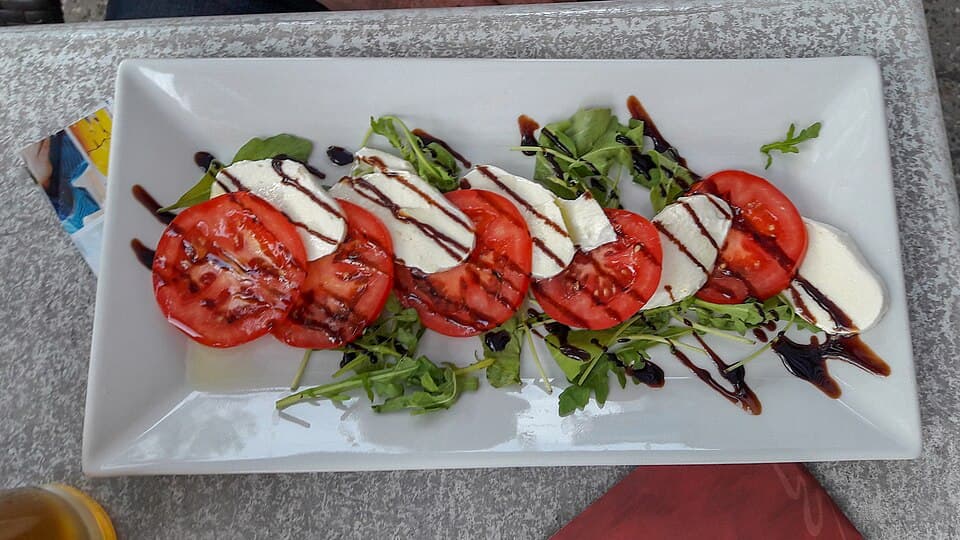
Few dishes in the European culinary canon achieve the combination of simplicity and cultural significance that the caprese salad commands. Built from three core ingredients — fresh mozzarella, ripe tomatoes, and fresh basil — the salad is a staple of Italian cuisine and a standard reference point for discussions of Mediterranean food culture.
Origins and Geographic Identity
The dish takes its name from Capri, the island situated in the Tyrrhenian Sea at the southern end of the Gulf of Naples in the Campania region of Italy. While the precise historical origin of the recipe is difficult to verify with documentary certainty, culinary historians widely associate the salad with Campanian food traditions, a region also responsible for producing buffalo mozzarella — one of the ingredient variants most closely associated with the dish.
The salad is frequently cited as a representation of the Italian national colors: the white of the mozzarella, the red of the tomato, and the green of the basil mirror the tricolor of the Italian flag. This association, whether intentional in origin or applied retrospectively, has become part of the dish's cultural narrative in popular food writing and Italian gastronomy circles.
Ingredients and Regional Variation
In its classic form, the caprese salad calls for buffalo mozzarella — mozzarella di bufala campana — which holds Protected Designation of Origin status under European Union law. This designation restricts authentic production to specific areas of southern Italy, including parts of Campania, Lazio, Apulia, and Molise. The certification system, administered through EU agricultural quality schemes, is intended to protect regional food heritage and ensure product authenticity across member states.
Variations of the dish exist across Italy and internationally. Some preparations substitute cow's milk mozzarella, known as fior di latte, for buffalo mozzarella. Others incorporate additions such as olives, prosciutto, or balsamic vinegar reduction, though these modifications are generally considered departures from the classic formula rather than accepted regional traditions.
Olive oil — typically extra virgin — is drizzled over the assembled ingredients as a finishing element. Salt and, in some preparations, ground black pepper complete the seasoning. The dish is served at room temperature rather than chilled, a convention rooted in the principle that cold temperatures suppress the flavor profiles of fresh mozzarella and ripe tomatoes.
Presence in European Culinary Culture
The caprese salad occupies a prominent position on restaurant menus throughout Italy and across much of continental Europe. In the United Kingdom, France, Germany, and Spain, the dish appears frequently as a starter or light course in Italian restaurants and in broader European dining establishments. Its accessibility — requiring no cooking and minimal preparation — has contributed to its widespread adoption.
The dish also serves as a point of reference in discussions of the Mediterranean diet, a dietary pattern associated with the traditional eating habits of countries bordering the Mediterranean Sea. International health and nutrition organizations have examined the Mediterranean diet extensively, and its emphasis on fresh vegetables, olive oil, and minimally processed foods aligns with the composition of the caprese salad.
Seasonality and Ingredient Quality
Culinary tradition and food professionals consistently emphasize that the quality of the caprese salad depends directly on the quality and ripeness of its ingredients. Tomatoes harvested at peak ripeness during summer months are considered essential to the dish's intended flavor profile, which has led to the salad being characterized as a seasonal preparation in contexts where locally sourced tomatoes are prioritized.
The dish's dependence on ingredient quality over technique distinguishes it from more complex preparations and reflects a broader principle within Italian culinary philosophy — that superior raw materials require minimal intervention to produce a successful result.
Open Questions
The precise historical moment and location of the caprese salad's creation remain subjects of culinary debate, with no single documented source confirming its invention. The extent to which international versions of the dish can legitimately claim the name, particularly when prepared with non-certified mozzarella, also remains an unresolved question within ongoing European discussions about food labeling and geographic indication protections.
Sources: European Commission — Protected Designations of Origin and Protected Geographical Indications; Italian Ministry of Agricultural, Food and Forestry Policies; World Health Organization — Mediterranean Diet documentation; Accademia Italiana della Cucina culinary records.
This article is based on a verified primary source. The text was editorially reviewed and fact-checked prior to publication.