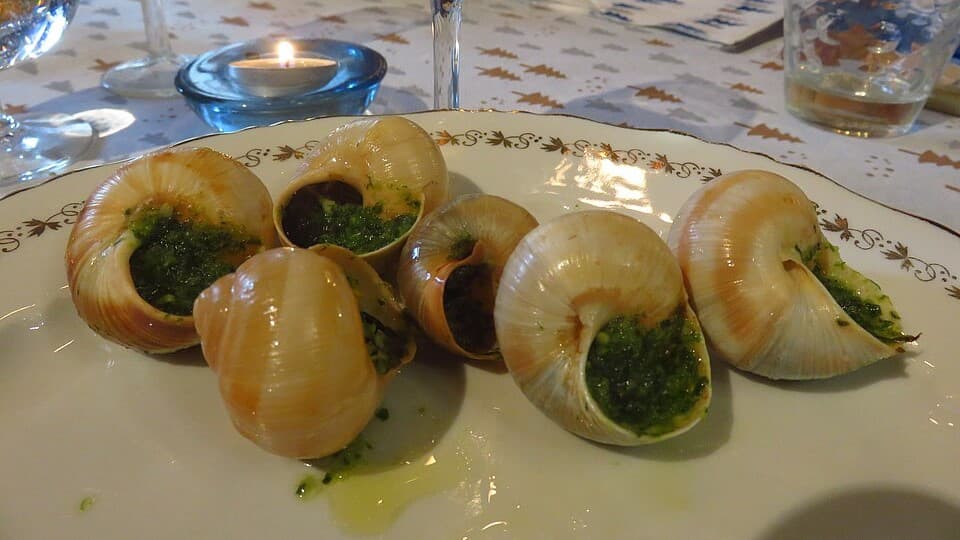
Few dishes carry as much regional identity as the snail preparations associated with Burgundy, the wine-producing heartland of eastern France. Escargots à la Bourguignonne — land snails served in their shells and filled with a compound butter of garlic, shallots, flat-leaf parsley, and sometimes a splash of dry white wine — represents one of the cleaner intersections of peasant economy and refined French gastronomy.
Origins Rooted in Necessity
The consumption of land snails in the Burgundy region predates modern culinary documentation by centuries. Archaeological evidence from sites across France and broader Europe indicates that snails were a reliable, protein-rich food source long before agriculture became systematised. In Burgundy specifically, the indigenous Helix pomatia — commonly known as the Roman snail or Burgundy snail — became the species most closely associated with local cooking, largely due to its size and abundance in the region's vineyards and forests.
The classical preparation that carries the Bourguignonne designation standardised over time, particularly through the formalisation of French regional cooking in the nineteenth and early twentieth centuries. The compound butter — beurre à escargot — became the defining element, its aromatic richness complementing the firm, mildly earthy texture of the cooked mollusc.
A Protected Culinary Identity
Burgundy snails are not merely a local curiosity. The Helix pomatia variety harvested in France has historically been subject to seasonal and quantity restrictions under French and European Union wildlife regulations, as populations came under pressure from habitat loss and overcollection. This regulatory environment shifted the commercial supply chain significantly, with producers sourcing snails from Central and Eastern Europe — particularly from countries such as Hungary, Poland, and Romania — where Helix pomatia populations remain more robust.
French producers and restaurateurs continue to work within a supply framework that distinguishes between wild-harvested and farmed snails. Heliciculture, the farming of snails, has expanded across France and neighbouring countries as a response to both conservation concerns and consistent demand from the restaurant industry.
Place on the French Table
In French culinary tradition, escargots à la Bourguignonne typically appear as a starter course. The snails are served in ceramic or metal dishes specifically designed with individual wells to hold each shell upright, accompanied by small tongs and a narrow fork. The presentation is considered part of the dining ritual, and specialist tableware for snails remains widely manufactured and sold across France and internationally.
The dish appears on menus ranging from modest bistros in Dijon and Beaune to Michelin-starred establishments in Paris. Its presence in French culinary education, including curricula at institutions affiliated with professional cooking bodies, reflects its status as a foundational preparation within the classical repertoire.
International Reach and Adaptation
Beyond France, escargots à la Bourguignonne gained significant international visibility through the post-war expansion of French restaurant culture. The dish became a marker of French dining authenticity in major cities across Europe, North America, and beyond. Adaptations emerged over time — some preparations substituting mushroom caps for shells, others incorporating regional cheeses or alternative herbs — though the Bourguignonne designation continues to reference the garlic-butter-parsley formula specifically.
The broader European appetite for snail-based dishes extends well beyond France. Spain, Portugal, Italy, and Greece each maintain distinct snail-eating traditions, though the Burgundian preparation remains the most internationally cited. Within France itself, the Burgundy region continues to leverage the dish as a cultural tourism asset, with food festivals and producer markets across the Côte-d'Or and Yonne departments maintaining active connections to the tradition.
Open Questions
Whether tightening EU biodiversity frameworks will further restrict wild Helix pomatia harvesting across member states remains an open regulatory question. The long-term viability of heliciculture as a full substitute for wild-harvested snails, both economically and in terms of flavour profile, continues to be assessed within the French food industry.
Sources: French Ministry of Agriculture and Food Sovereignty (agriculture.gouv.fr), European Commission wildlife trade regulations, Institut Paul Bocuse curriculum documentation, IUCN species assessments for Helix pomatia, Larousse Gastronomique (standard culinary reference edition).
This article is based on a verified primary source. The text was editorially reviewed and fact-checked prior to publication.