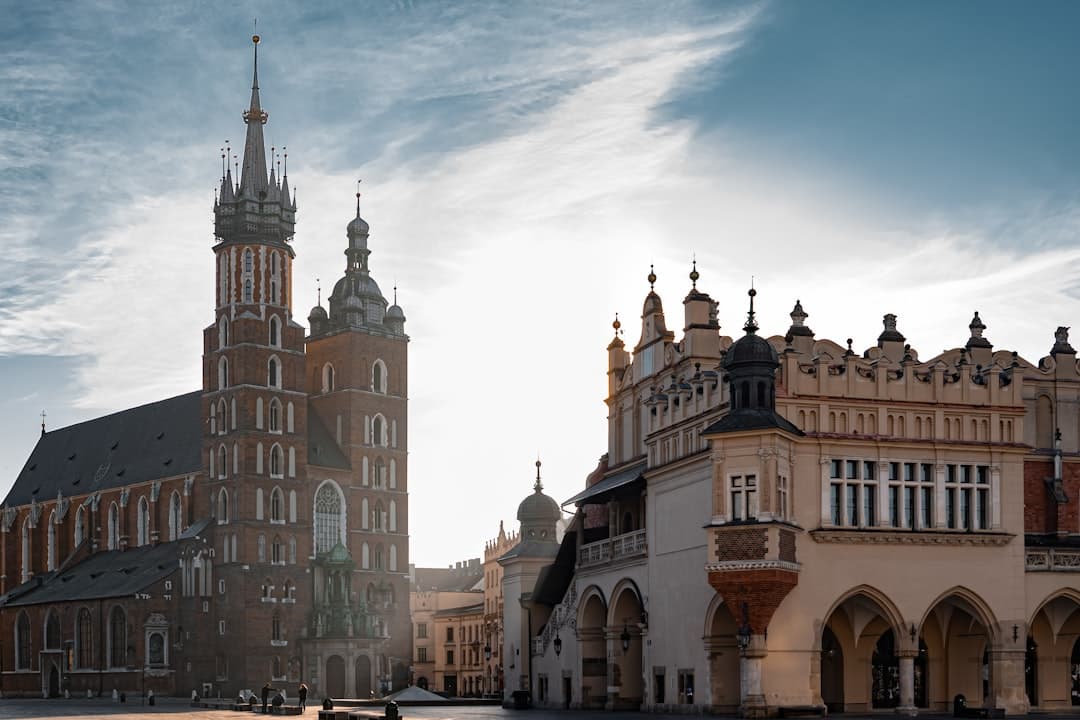
Poland occupies a distinctive position in European history, having served as a crossroads of dynastic power, commerce, and religious influence throughout the medieval period. That legacy endures in the physical landscape of its cities and in the academic and cultural conversations that shape European heritage policy.
Royal Kraków and the Jagiellonian Influence
Kraków, the seat of the Polish royal court for centuries, remains one of Central Europe's best-preserved medieval capitals. Wawel Castle and its cathedral complex on the Vistula riverbank stand as architectural records of Jagiellonian dynastic rule, a dynasty whose reach extended across Lithuania, Hungary, and Bohemia at its height. The Jagiellonian University, founded in the fourteenth century, ranks among the oldest continuously operating universities in Europe, and its medieval heritage contributes to ongoing academic exchanges across the continent.
Gothic Architecture and the Hanseatic Connection
The northern city of Gdańsk illustrates a different dimension of Poland's medieval past. As a prominent member of the Hanseatic League, the city developed a dense concentration of Gothic brick architecture that still defines its historic waterfront. This style of construction, common to the Baltic region, links Polish urban heritage directly to cities such as Lübeck, Tallinn, and Riga, reinforcing shared northern European cultural ties.
UNESCO Recognition and Conservation Standards
Several Polish medieval sites hold UNESCO World Heritage status, including the historic centres of Kraków and Warsaw, as well as the Teutonic Order's Castle of Malbork — the largest brick castle in the world by surface area. These designations have made Polish sites reference points for conservation methodology debated in broader European institutions.
Living Heritage in Contemporary Europe
Beyond tourism, Poland's medieval heritage informs architecture curricula, urban planning discussions, and EU-funded restoration projects. The country's experience in rebuilding and preserving war-damaged historical centers, particularly Warsaw's Old Town, has been studied by urban planners working in conflict-affected regions elsewhere in Europe.
Open Questions
How will increased tourism pressure affect the physical integrity of Poland's most visited medieval sites? What role will EU structural funds play in sustaining smaller, less prominent heritage towns beyond the major urban centers?
Sources: UNESCO World Heritage List (whc.unesco.org), Jagiellonian University institutional history, Hanseatic League historical records, Polish National Heritage Board (nid.pl)
This article is based on a verified primary source. The text was editorially reviewed and fact-checked prior to publication.


